Monitor lizards are quite widespread throughout Thailand and South East Asia, the largest of the species being the Asian Water Monitor. In Thailand, all monitor lizards are protected, but not necessarily always held in high esteem. A common name for them is “Hia,” an insulting swear/curse word that you should never call a Thai person.
I spotted this monitor lizard pictured below basking in the sun in Khao Sam Roi Yot National Park, Thailand, whilst on my way to Tham Phraya Nakhon Cave. He was happy to pose for a few pictures, but retreated back under the concrete slab that must have been his home, once I got too close.
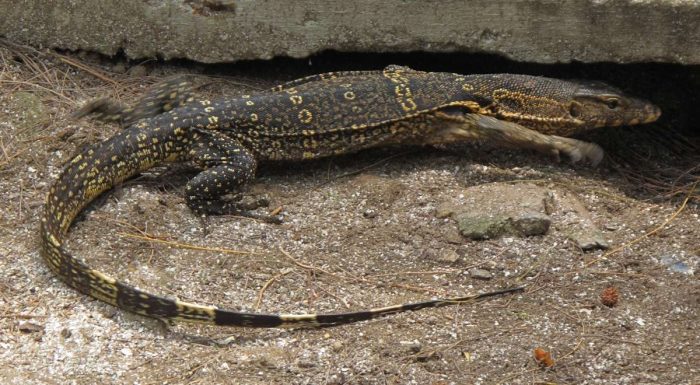
Places you might see monitor lizards in Thailand include National Parks such as Khao Yai, but expect to see them anywhere where there is water. Lumphini Public Park in Bangkok famously has a few resident monitor lizards which have become accustomed to Humans.
Monitor Lizards in Pattaya
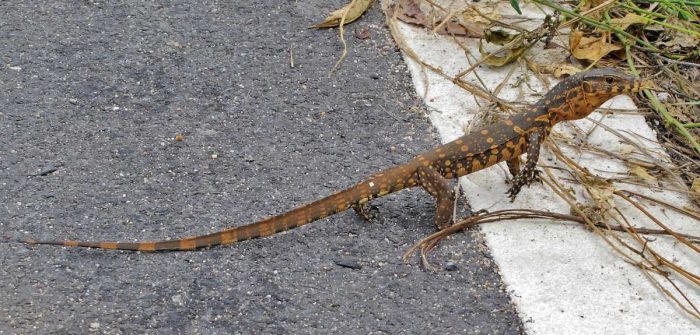
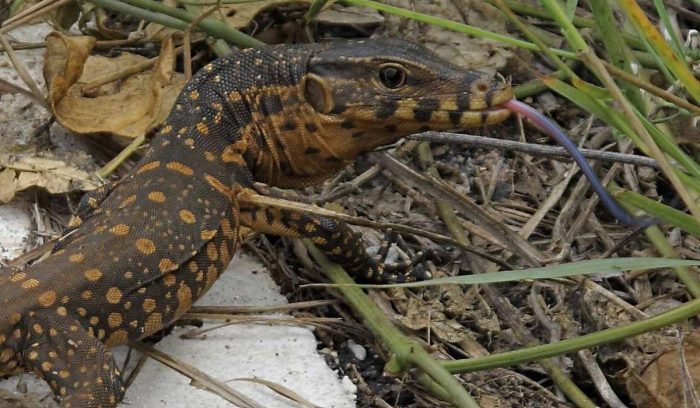
Don’t be surprised if you see a monitor lizard crossing the road. They are commonly seen in built-up areas; even the sprawling metropolis of Pattaya has resident monitor lizards. Monitor lizards are often spotted in the area around Na Jomtien Beach.
The 2 photos below are of a young monitor lizard I saw on the backroads near Na Jomtien Beach near Pattaya.
At Nong Prue Park, if you enter/exit near Highway 7, there is a canal/drain, that’s home to monitor lizards. They are quite shy, though, so you need to be stealthy.
There is a colony of monitor lizards at Sai Kaew Navy Beach. They are not too shy here, and you are likely to see them basking in the sun where the beach borders their swampy natural habitat.
Are monitor lizards in Thailand dangerous?
Monitor lizards can grow up to 9 feet long but will more commonly reach lengths of 5 or 6 feet. They may live as long as 15 years. They are territorial, but only aggressive towards humans as a last resort, if you have one cornered for example.
If you have a problem with monitor lizards in Pattaya, have one in your house or took up residence on your land and you would like to have it removed, you should call 1337.
Monitor lizards are not venemous, but their saliva contains harmful bacteria, so If you happen to be bitten by a monitor lizard, see a doctor or go to hospital as soon as you can.