
Of all the weird and wonderful bugs in Thailand, large and small, this one “creeps me out” the most. It truly is a “creepy crawly” in every sense. This giant centipede (see pictures below) has quite a fearsome reputation in Thailand. Those unfortunate enough to have been bitten by this monster centipede typically describe it as excruciatingly painful, often lingering for several days.
I believe the correct name for this centipede is the Vietnamese Centipede (Scolopendra subspinipes). It is found in Southeast Asia and tropical and sub-tropical regions worldwide.
Thais often refer to them as Takhab Fai, with takhab meaning centipede (ตะขาบ), and fai meaning fire. As they are one of the most dangerous bugs in Thailand and generally not well-liked, you may hear a Thai call out “takhab!” on seeing one, preceded by some choice Thai swear words.
It can grow to a monstrous 10–12 inches in length and live for up to 10 years. I estimate the one in these photos is between 7 and 8 inches in length and long dead.
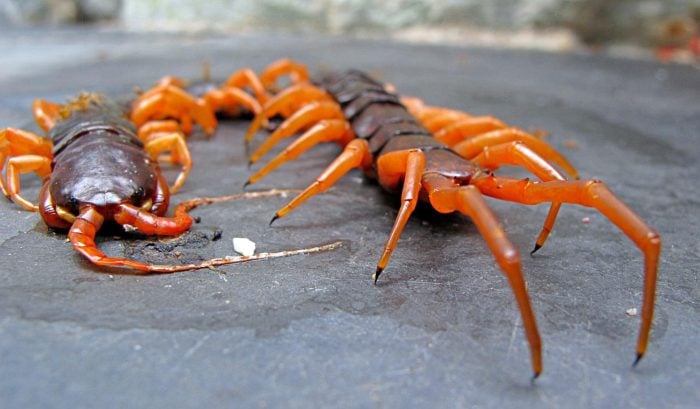
The Vietnamese centipede has a head with venom claws (forcipules) and a further 21–23 body segments, with each segment having a pair of legs. Source: https://en.wikipedia.org/wiki/Scolopendra_subspinipes.
Although it’s difficult to tell for sure due to the damage, the one on this page appears to have 21 body sections plus the head when I magnify the original image.
It’s only the second time I have seen one of these monster centipedes in Pattaya. Fortunately, they were both dead. The one in the photos was on the footpath near the steps down to the Pattaya Sign and Bali Hai viewing point, and by the looks of it, someone killed it by bashing it with a stick.

If you happen to come across one of these centipedes in Thailand, treat it with caution. If you aggravate them, they will bite. They have specially adapted front legs that act as pincers, which they use to catch their prey and then inject it with venom to kill it. The centipede will use these same pincer-like legs to bite you.
In Thailand, giant centipedes might be found underneath rocks and tree logs, in damp foliage, or partially buried in loose, damp soil. They have also been known to shelter inside shoes.
They are nocturnal and feed on insects and small animals of a similar size to themselves, including lizards, frogs, and small rodents.
A bite from one of these centipedes is extremely painful, and the pain can last for four or five days. Severe swelling and bruising often result from being bitten. Some people may suffer more adverse effects, such as breathing difficulties and a rapid heartbeat. If bitten, it’s best to seek medical care, especially for children or if symptoms are severe.
